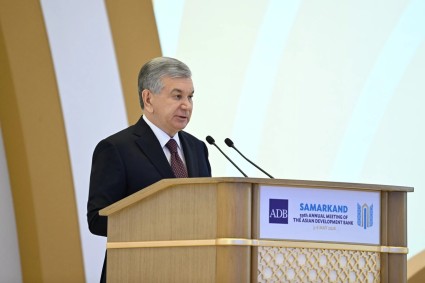
Speaking at the Asian Development Bank Board of Governors meeting today, President Shavkat Mirziyoyev proposed the development of a program to scale artificial intelligence across developing countries, the establishment of a regional hub in Tashkent for the Digital Highway for Asia initiative, and the creation of a Green Belt and a Central Asia Tourism Ring.
Shavkat Mirziyoyev noted that Uzbekistan and the ADB have outlined plans to expand cooperation in poverty reduction, human capital development, and modern infrastructure construction.
"Yesterday, we signed a new $12 billion cooperation program with the Bank," the president stated.
"In the face of complex shifts in the global economy and the rapid advancement of new technologies, countries must work alongside the ADB to introduce new mechanisms for sustainable development."
"Digital technologies and artificial intelligence are the first priority area, while AI is transforming virtually every sector of the economy into a new paradigm."
"According to World Trade Organization projections, artificial intelligence is expected to generate an additional 40% growth in global trade volumes by 2040."
Mirziyoyev announced that Uzbekistan has begun establishing an innovation- and knowledge-based Artificial Intelligence Hub. More than 200 AI projects are currently being implemented across various sectors of the economy. Work is also underway to expand the number of data centers, supercomputers, and AI laboratories across the regions, as well as to train what the country has called Five Million AI Prompters.
"Without question, the use of open AI models is essential in the sectors most in demand by the population — education, healthcare, water management, ecology, and food security".
In this context, Uzbekistan proposed the development, under the auspices of the ADB, of a dedicated program to scale artificial intelligence across developing countries.
"We also announce our accession to the Bank's 'Digital Highway for Asia' initiative and put forward a proposal to open its regional coordination center in Tashkent," Shavkat Mirziyoyev declared.
The president identified energy as the second priority area. He noted that the rapid advancement of digital technologies and AI is dramatically increasing demand for energy resources.
"Analysis by the International Energy Agency found that electricity demand from data centers is projected to grow two to three times compared to current levels by 2030."
"In such conditions, only those states that can offer investors cheap, reliable, and clean energy will remain competitive in the global market," he said.
The president highlighted that, in partnership with leading global companies, Uzbekistan has brought large-scale wind and solar power plants online with a combined capacity of 5,600 MW — bringing the share of renewable energy in total electricity generation to 30%.
"By 2030, we plan to raise that figure to 54%," Mirziyoyev said.
He also acknowledged the ADB's support for the creation of the Central Asia - Europe green energy corridor.
"We hope that the countries of the region, in cooperation with the Bank, will soon move forward with the implementation of this 'energy artery' project," the president stated.
Shavkat Mirziyoyev identified transport connectivity and the stability of logistics corridors as the third priority area.
"The disruption of logistics corridors due to various conflicts and tensions around the world is already driving up transport costs for Central Asian countries by as much as 30%, while delivery times are increasing by several weeks," he said.
The president recalled the launch of the China–Kyrgyzstan–Uzbekistan railway project, which is set to link East and West.
This new transport route is expected to significantly boost the transit potential of the entire region. Delivery times will be cut to as little as 10 days, and the line will have the capacity to carry up to 15 million tons of cargo per year.
In this context, Uzbekistan proposed the establishment of a "Digital Customs and Logistics Alliance" under the CAREC program. According to the president, this would harmonize customs procedures, digitize documentation workflows, and streamline cross-border freight transportation.
The fourth area concerns expanding cooperation with the private sector with ADB involvement, including in the field of critical minerals.
"According to international expert assessments, demand for minerals vital to industry is projected to grow sixfold by 2040. This represents a significant opportunity," said Shavkat Mirziyoyev.
The president noted that Uzbekistan holds substantial reserves of copper, tungsten, molybdenum, magnesium, graphite, vanadium, titanium, and other mineral resources. In partnership with Korean counterparts, an R&D center has been established and a "Future Metals Technopark" is under construction in the Tashkent and Samarkand regions. More than 70 projects worth $1.6 billion have been launched with companies from the United States, China, and Turkey.
"Our goal is not merely to extract raw materials, but to give a new impetus to economic development through their deep processing and value-added transformation," the president declared.
Uzbekistan proposed joining the ADB's "From Critical Minerals to Manufacturing" program and implementing high-value-added projects within its framework.
The president identified the fight against the consequences of climate change and desertification as the fifth priority area.
He noted that under the nationwide Yashil Makon (Green Space) project, Uzbekistan plants 200 million seedlings annually. Some 2 million hectares of protective forest plantations have been established on the dried bed of the Aral Sea. Uzbekistan has set itself the goal of raising its greenery coverage to 30% by 2030.
The president proposed the implementation of a regional project called the "Green Belt of Central Asia."
Shavkat Mirziyoyev identified tourism development as the sixth priority area. "In an era of global instability, millions of tourists are seeking safe destinations," he observed.
According to the president, Central Asia holds enormous potential in pilgrimage, cultural, gastronomic, ethnographic, adventure, and medical tourism. As a result of the reforms carried out, the flow of foreign tourists to Uzbekistan has grown sixfold over ten years, reaching 12 million visitors per year.
The head of state highlighted the recently opened Center of Islamic Civilization in Tashkent and the Imam Bukhari Memorial Complex in Samarkand.
"We therefore put forward an initiative to create a 'Central Asia Tourism Ring' — a unified tourism space bringing together the countries of the region. We call on our neighboring states, the Asian Development Bank, and our other partners to form a project portfolio for tourism development and co-finance these projects together," the president said.
In closing, Shavkat Mirziyoyev stated that Uzbekistan is prepared to implement the proposed initiatives in partnership with the ADB not only through sovereign lending, but also via public-private partnerships, guarantees, blended finance, and private capital mobilization.
"In this regard, we propose the establishment of an Innovative Platform for Financing Regional Projects," the president said.