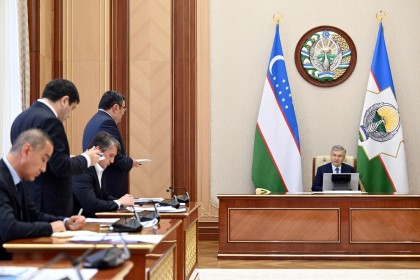
On April 29, president Shavkat Mirziyoyev reviewed a presentation outlining strategic measures to further develop Uzbekistan’s hydropower industry.
"The issue of hydropower is of paramount importance today," the president stated during a report by the Uzbekistan 24 TV channel. "Global shifts in energy security have shown that economic calculations, revenue, growth, and overall stability are now heavily dependent on the energy sector."
He pointed out that while the country possesses over 150,000 kilometers of rivers, canals, and streams, a significant portion of their energy potential remains untapped.
"Water is vital not just for drinking and irrigation; it has a direct impact on our energy, economy, and environment," Mirziyoyev noted. "Our primary challenge is that the majority of our electricity generation still relies on gas and coal. I have issued several decisions on this matter, and today I want to hear concrete proposals and plans for the evolution of our hydropower sector."
Between 2017 and 2025, the number of hydroelectric power plants in Uzbekistan rose from 36 to 100, with total capacity increasing from 1.6 to 2.4 GW. Looking ahead to 2026–2032, the government plans to implement 73 projects worth a combined $5.8 billion, aimed at adding an additional 3.6 GW of capacity.
Plans for 2026 include the commissioning of 13 hydroelectric power plants (HPPs) with a combined capacity of 114 MW. These facilities are expected to generate 537 million kWh annually and create 254 new jobs.
One of the flagship initiatives is the Upper Pskem HPP, a $365 million project. With a capacity of 160 MW and an annual output of 484 million kWh, this plant is set to power over 160,000 households. Notably, 82% of the project’s components will be sourced locally. Furthermore, a 20 MW wind farm is currently under construction in the Bostanlyk district, funded by $28 million in grants.
In the Sokh district of the Fergana province, the Sokh HPP is being developed as a "national project." This 15 MW station will produce 50 million kWh of electricity per year, reliably covering 71% of the district's total power needs.
The president also reviewed the untapped hydropower potential of the Upper Tupalang waterways. By constructing 42 small HPPs on the rivers and streams feeding into the Tupalang reservoir, the country could unlock 541 MW of capacity and generate approximately 1.9 billion kWh of electricity annually.
Additionally, officials are considering the construction of three pumped-storage hydroelectric plants with a massive combined capacity of 1.4 GW to aid in energy storage and grid redistribution. This is alongside plans for 2,983 small and micro-HPPs, which would contribute a further 164 MW to the national grid.
Follow us on: