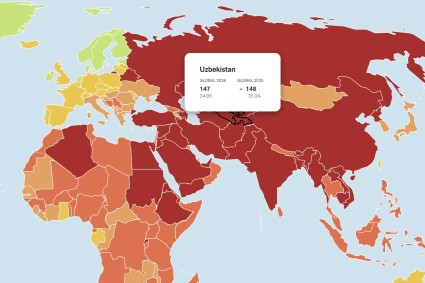
Reporters Without Borders (RSF) has released its annual 2026 World Press Freedom Index, on which Uzbekistan climbed one spot compared to last year, ranking 147th out of 180 countries. Despite this slight rise in position, the country’s press situation remain “Very Serious”, with its overall score actually dropping from 35.24 to 34.95 points. This decline was reflected in three of the five key indicators: political context, legal framework, and sociocultural context. Conversely, the scores for the economic framework and safety saw modest improvements.
Eastern Europe and Central Asia
Eastern Europe and Central Asia (EECA) remains in second-to-last place in the regional ranking of the 2026 World Press Freedom Index, while the European Union–Balkans zone has held onto first place despite a drop in journalism conditions.
With the exception of Kosovo (84th out of 180 countries and territories in the Index, +15 places since 2025), which saw an improvement despite remaining one of the lowest-ranking countries in Europe, press freedom in the Western Balkans is generally getting worse. Although Albania (83rd, -3), Bosnia and Herzegovina (90th, -4) and Serbia (104th, -8) aspire to join the European Union (EU), all three countries are hostile to journalism and vulnerable to propaganda. Moldova (31st) is still the only country in Eastern Europe that falls into the “satisfactory” category for press freedom. The average of each indicator in Eastern Europe and Central Asia has declined, particularly the legal one.
Weaponising legislation to bring the media into line
Several converging dynamics explain this widespread decline in press freedom. The region increasingly resembles a vast experiment where established values are turned on their head and legislation is used to serve those in power at the expense of the right to inform. After more than a year of democratic crisis and crackdowns on protests and their coverage, Georgia (135th) has fallen 21 places in the Index. The adoption and enforcement of restrictive laws — particularly on “foreign agents” and media funding — and new barriers to accessing information point to a clear erosion of the rule of law. In Armenia (50th), where the state of press freedom is now classified as “problematic,” the drop in the legal score is explained by a rise in abusive defamation lawsuits and legislative projects that have had a deterrent effect on news outlets.
In Kazakhstan (149th; -8), the country’s tightening legislation has been accompanied by indirect pressure on the media, repressive policies expanding into the online information space, and a climate of impunity for crimes against the press. Kyrgyzstan (146th) is also following this trend, notably due to weakened legal safeguards for journalists. At the very bottom of the ranking, Belarus (165th), Azerbaijan (171st), Russia (172nd) and Turkmenistan (173rd) have some of the lowest legal scores in the world, ranging between 22 and 32 points out of 100. In Belarus and Russia — which is the world’s second-largest prison for journalists and the largest for foreign reporters (all of whom are Ukrainian) — anti-terrorism and anti-extremism laws are regularly used to criminalise reporters’ work.
In this context, Ukraine (55th, +7) stands out as a relative exception, with a slight improvement in its overall score despite Russia’s war of aggression. This progress is notably due to the country’s dynamic media sector and the investigative work carried out by Ukrainian outlets to strengthen transparency in the country’s political life.
Follow us on: