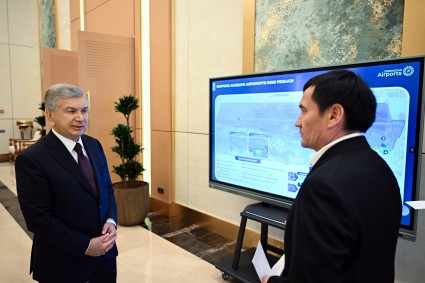
During his visit to the Fergana province on Tuesday, president Shavkat Mirziyoyev reviewed the development concept for the modernization of Fergana International Airport.
The existing terminal has been in use for over 30 years and no longer meets modern standards for passenger capacity, comfort, or the expansion of aviation and commercial services.
The proposed project outlines a comprehensive overhaul of the airport’s infrastructure. Key plans include lengthening and widening the runway, upgrading airfield facilities, and constructing brand-new passenger and cargo terminals.
The new passenger terminal will span approximately 20,000 square meters, effectively doubling the airport's capacity to 1,200 passengers per hour. Additionally, aircraft parking stands will be increased to ten. The facility will feature spacious lounges, modern service areas, streamlined check-in and security systems, and dedicated facilities for hosting official delegations.
The president emphasized that the airport serves as the "gateway" to the province and offered recommendations for enhancing service quality, transportation links, and supporting infrastructure. He further directed that the design and management of the facility adhere to international standards, with the involvement of experienced foreign operators.
The project is expected to significantly enhance connectivity within the Fergana Valley, drive tourism growth, and solidify the province’s status as a major logistics hub.
In August 2020, the president directed the development of a framework, in collaboration with the World Bank, to outsource the management of the Tashkent, Bukhara, Fergana, and Urgench airports using a "package deal" approach—where underperforming airports are bundled with profitable ones for private management. At the time, international experts estimated that modernizing the country’s existing airports would require an average investment of $800 million.
In June 2022, Rano Juraeva, the former Board Chair of Uzbekistan Airports, advocated for the construction of a single, unified airport to serve the Andijan, Namangan, and Fergana provinces. During a presentation of the airport development strategy through 2035, two potential scenarios for the Fergana Valley were proposed to the president.
The first option involved renovating and expanding facilities at their current locations. However, a SWOT analysis revealed major drawbacks: all three provincial airports are situated within city limits, allow for landing approaches from only one direction, and are capped at a low capacity of just six flights per hour.
The second scenario proposed building a single, centralized airport for the entire Fergana Valley at a new site. According to Juraeva, this model aligns with the demands of international investors and operators, who typically require a "non-compete" clause in concession agreements, insisting that no rival airports operate within a 300-kilometer radius.