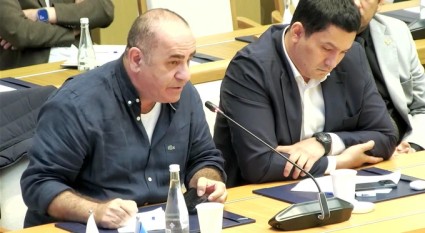
Restaurateurs and cafe owners have voiced sharp criticism over the implementation of Tashkent’s new "design code," reporting threats of power cuts if they refuse to immediately dismantle their signage. These grievances were aired on April 23 during an open dialogue organized by the Chamber of Commerce and Industry of Uzbekistan.
Kemal Kaya, founder of the Giotto gelato chain, labeled the design code "amateurish" and slammed its developers. He described a chaotic situation at his branch on Uzbekistan Ovozi Street (C-1) this week, which unfolded just ahead of a presidential visit to the area.
"The mayor reached out to me with a request. You asked for a certain color—we did it, no problem. But it turned out hideous," Kaya said. "First, they said it had to be a cream color... I have the proof right here [on my phone], they sent it themselves. They said the bottom should be pine. I paid the money and brought in the materials. A day later, they came back and said, 'Wait, let Giotto keep its blue; the brand is established, let it stay.' I said fine. A day after that, they come back and say, 'No, it has to be gray.' We redid it in gray that evening; the workers didn't get home until 4:00 AM. It looked terrible. Nobody liked it—not even the mayor’s office staff."
The restaurateur emphasized that the proportions mandated by the design code—specifically limiting sign lettering to 50 cm—are impractical and stifle business, particularly for international brands.
"You are embarrassing the country in front of all of Europe... You couldn't pull a project like this in any normal country, I’m sorry. It just doesn't work this way," he noted. "The Italians are laughing at us. Papa Johns is facing the same issue. Everyone is. Why is this happening? It’s not just the administration; it’s the people who designed this project. Because of their mistakes, it’s hard on the city, it’s hard on you, and it’s hard on the people. Everyone is suffering... You’re turning Uzbekistan into North Korea."
According to the speaker, he was not merely voicing a personal opinion but representing the collective stance of architects. He urged authorities to establish clear, definitive standards for facade colors and signage specifications, noting that some areas, such as the Yakkasaray district, have demonstrated a far more thoughtful approach to urban design.
Rushana Khasanova, head of development projects at "Tashkent Invest" (under the city administration) and lead developer of the design code, maintained that the authorities remain open to discussing the document.
However, Bobur Talipov, representing the holding company for Papa Johns and EvoEva, countered by highlighting the aggressive, forceful methods being used on the ground.
Khasanova pointed out that the project had been available for public consultation for two weeks and was reviewed by the Kengash (Council) of People's Deputies before being finalized.
"I am not the one in charge of the demolitions. I am the manager who developed the design code... We are open to communication. This document was posted for public discussion for two weeks before it was published. We brought it to the council; we discussed all of this," she said.
She added that she, too, is opposed to "flash demolitions" carried out without prior warning.
As previously reported by Gazeta.uz, the project was developed by the Russian firm CM International, which has been working on the initiative under contract for "Tashkent Invest" since early 2024.
Since March, Tashkent’s district administrations have been conducting large-scale raids to remove outdoor advertising. Officials have categorized storefront signs as advertising, justifying their removal as a necessary step to unify the capital’s architectural aesthetic. However, business owners argue that these signs are not ads but essential navigation tools; without them, customers simply cannot find their destinations.
Entrepreneurs said that the authorities’ aggressive tactics and threats of retaliation have led to staggering financial hits. Some companies have reported losses of up to $12,000 per location, while others have been forced to shut down their businesses entirely.
The business community identifies the primary obstacle as a total lack of constructive dialogue and clear, predefined regulations for installing signage.
According to government plans, the new design code is set to be implemented across 36 streets covering 432 km by the end of the year. Dismantling work has already begun on a 100 km stretch spanning 14 streets. Reports indicate that 6,113 entrepreneurs have already been served notices requiring them to replace their storefront signs.
Davron Vakhabov, Chairman of the Chamber of Commerce and Industry, pledged to meet with the Mayor of Tashkent to negotiate a temporary moratorium on removals for the remaining 332 km of roadways until the initial 100 km phase is properly managed. The following day, the Chamber announced an agreement: the 14 streets where removals had already occurred would be brought up to a unified standard. For the remaining 472 km, updates will be phased in over 30 days without immediate forced removals.
Entrepreneurs also voiced frustration over the sheer density and complexity of the design code itself, which spans a staggering 254 pages. While business representatives clarified they are not opposed to improving city aesthetics, they pointed to the massive financial burden: replacing a single sign can cost up to 20 million soums, while quarterly fees for "advertising passports" for major retail chains can run into the tens of millions.
As of November 2025, approximately 2,000 signs have already been stripped down as part of the crackdown on "illegal advertising" and in preparation for the design code rollout.
Follow us on: