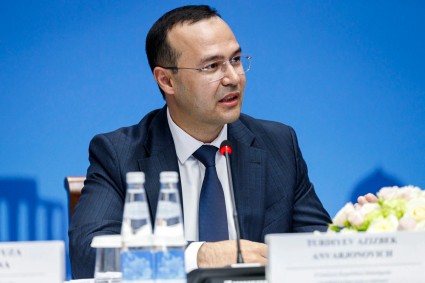
Issues surrounding the quality of education, the results of international assessments, and the widening gap between schools were at the forefront of a press conference held by Uzbekistan’s Ministry of Preschool and School Education on April 21, reports a Gazeta.uz correspondent.
According to Jalilov, the Program for International Student Assessment (PISA) and the Organisation for Economic Co-operation and Development (OECD) both recommend against diversifying educational tracks, as doing so exacerbates inequality.
"Yet we are doing the exact opposite: we are increasing the number of Presidential and specialized schools," he noted.
Jalilov also pointed out that the prevalence of rote learning remains a major hurdle.
"International studies evaluate practical skills, but we are still testing memorization—this is evident in both teacher certifications and the school grading system," the expert said.
He emphasized that if the government is spending significant resources to participate in these global assessments, their findings must be put into practice.
The Deputy Minister of Preschool and School Education, Azizbek Turdiev, acknowledged the issues brought to light by the PISA results. He admitted that international research confirms the education system’s heavy reliance on rote memorization.
However, the Deputy Minister noted that reforms are already underway. "We are introducing project-based learning in schools, designed to shift the focus from simple memorization to the practical application of knowledge," Turdiev added.
According to him, the impact of these changes will be felt in the coming years and should be reflected in future PISA scores.
Addressing the widening gap between schools, Turdiev argued that international models cannot be carbon-copied onto Uzbekistan.
"Every country follows its own educational path. For example, Finland has one of the best systems in the world, where conditions in rural and urban schools are identical. But there, the minimum requirement for a teacher is a master’s degree. Here, we are still debating the necessity of basic B2 and C1 language proficiency certificates," he said.
He explained that Uzbekistan manages approximately 11,000 educational institutions, and bringing them all up to a uniform standard requires significant time and resources.
"The Ministry would be thrilled if every single one of our schools met the standards of our specialized institutions. But this is a gradual process. In my view, it’s not entirely fair to jump to the conclusion that nothing is being done," the Deputy Minister remarked.
The issue of transparency regarding PISA outcomes was also raised during the press conference. Abduvali Ismoilov, Director of the National Center for International Assessments of Education Quality, announced that the national report has been completed.
Ismoilov explained that while the national report is ready, it has not yet been made available to the public due to specific minor translation errors that still need to be addressed.
He added that following the release of the PISA results, customized action plans were developed for every region.
"We have signed 'roadmaps' with all 14 provinces, each featuring between 21 and 27 specific initiatives," he noted.
During the press conference, officials also announced the rollout of new professional development systems for teachers.
Addressing infrastructure challenges, the president reported late last year that Tashkent alone faces a deficit of 75 schools and kindergartens, as well as 23 sports complexes, due to the city’s rapid annual population growth. He instructed regional governors to fund the construction of at least one new facility annually through private investment, while the remaining projects will be covered by state investment programs.
The scale of the challenge is further highlighted by a recent IMRI analysis: by the end of 2023, 70% of schools in Uzbekistan lacked a sewage system, nearly 30% had no running water, and over a third were without a cafeteria. Additionally, 21% of schools lacked a gym, and 5% did not have a library.