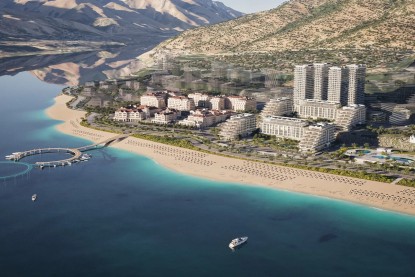
The Tashkent Provincial Branch of the Center for State Environmental Expertise has issued a positive finding on the first stage of the Environmental Impact Assessment (EIA) for the Sea Breeze Uzbekistan year-round resort.
The approval, issued on February 10, 2026, remains valid until February 10, 2029.
To move forward, Sea Breeze Uzbekistan must conduct additional engineering-geological, hydrological, geodynamic, botanical, and zoological studies. Furthermore, they are required to submit comprehensive calculations regarding air and water quality, soil integrity, biodiversity, transport logistics, and emergency response scenarios.
About Project
The project involves the construction of a year-round tourism complex spanning approximately 577 hectares in the Bostanlyk district. The site is situated between the settlements of Yakkatut and Boladala, along the eastern shore of the Charvak Reservoir.
The complex’s boundaries encompass nearly 7 kilometers of shoreline, a coastal terrace, and the slopes of the western foothills of the Pskem Ridge. The environmental assessment highlights the area’s challenging topography, characterized by sharp elevation changes and a high susceptibility to erosion and geodynamic shifts due to its proximity to the reservoir. An additional risk factor identified is the Kalash-say valley, an area prone to flooding, erosion, landslides, and potential mudflows.
The project outlines a phased construction plan spanning 10 years, with the initial phase focusing on the development of approximately 100 hectares. The complex is set to feature a diverse array of facilities, including hotels and apartments, a community center with a waterfront promenade, resort and boutique hotels, private residences, and villas. Additionally, the plans include a MICE center for large-scale corporate events, a sports and entertainment cluster featuring a 2,000-seat amphitheater, and a dedicated medical cluster.
The environmental assessment specifically emphasizes that the medical cluster will require a heightened sanitary-ecological regime, with rigorous oversight regarding waste management and wastewater treatment.
The document identifies several potential risks associated with the development, including:
- Contamination of the Charvak Reservoir waters;
- Acceleration of erosion and landslide processes;
- Increased pressure on coastal ecosystems;
- Growing transport and recreational demands;
- Inadequacy of existing water supply and sewage infrastructure.
The assessment places a particular spotlight on the environmental sensitivity of the Charvak Reservoir itself. Experts stress that the reservoir is a strategic water management site. Consequently, the project must prioritize the prevention of surface water pollution, uncontrolled runoff, and the cumulative impact generated by construction and increased traffic along the eastern shore.
The coastal zone is identified as the most sensitive area of the project, featuring a planned beach strip spanning roughly 7 kilometers and covering approximately 20 hectares. To protect this area, the plan includes a shoreline buffer zone, ranging from 100 to 300 meters wide, which must remain free of any permanent structures.
A critical finding of the assessment is the severe shortage of engineering infrastructure on the reservoir’s eastern shore. Currently, the villages of Boladala and Yakkatut lack centralized sewage networks and treatment facilities; the existing reliance on cesspools and local septic tanks poses a significant risk of contaminating soil, groundwater, and surface waters.
Consequently, the environmental report classifies the development of a comprehensive sewage infrastructure for the entire eastern shore as a mandatory prerequisite for the project’s realization, rather than just a localized technical requirement.
The proposed plan includes overhauling the water supply system, constructing a new pipeline, and establishing a secondary water source with an intake directly from the Charvak Reservoir. It also calls for a wastewater management system equipped with a pumping station to divert sewage into existing infrastructure for eventual transport to the Chirchik treatment plants.
However, the experts noted that the documentation for this initial stage lacks complete details regarding water sources and precise calculations for daily and annual water consumption and discharge. These figures must be strictly clarified in the next phase of the project.
Experts also pointed out gaps in the atmospheric impact assessment. While the documentation estimates construction-phase emissions at 90.041 tons per year—99.8% of which is inorganic dust from earthworks—it fails to account for vehicle emissions. Given that the project anticipates a daily recreational load of up to 10,000 visitors and a staff of 7,000, the current air quality assessment is considered incomplete. It must be revised to include both current and projected traffic volumes to be deemed reliable.
A separate set of requirements focuses on biodiversity. The report notes that no on-site botanical surveys were conducted during the initial stage; these are now mandated for the spring season. While the primary habitats for rare and endangered species are concentrated within the Chatkal State Biosphere Reserve and fall outside the construction zone—thereby avoiding direct impact on key ranges—the project must still preserve valley ecosystems, migration paths, and ecological corridors. If these conditions are met, the impact on local wildlife is expected to remain localized and manageable without threatening provincial ecosystem stability.
Furthermore, the developer is required to submit a comprehensive list of Red Data Book species, a formal land survey report, and an assessment from the Institute of Zoology of the Academy of Sciences regarding the project’s impact on ecologically sensitive zones. A detailed biodiversity management plan is also mandatory. Additionally, the document stipulates the preservation or relocation of valuable flora, such as the Zerafshan juniper and Persian walnut, along with a plan for compensatory planting that justifies relocation sites and ensures long-term survival rates.
The assessment concludes that the project may proceed only under the strict condition of continuous environmental monitoring. This must include monthly water quality testing of the Charvak Reservoir and the Kalash-say stream, oversight of the 300-meter water protection zone, and monitoring of slope stability along the stream and the 4R-10 highway. Additionally, seasonal checks on the health of forest areas and compensatory plantings are mandatory.
However, the documentation currently lacks a comprehensive environmental monitoring plan for the construction phase, failing to specify timelines, specific activities, responsible parties, or oversight mechanisms.
In summary, while the environmental board has not rejected the Sea Breeze Uzbekistan project, it has only approved the initial stage of environmental review and has mandated a series of critical revisions. The project is considered viable only if its parameters are refined through further research and strict adherence to conservation requirements in subsequent phases.
The assessment emphasizes that the project’s realization is contingent upon the step-by-step refinement of construction parameters, the completion of all mandated studies, and the strict integration of these findings into the next phase of the Environmental Impact Assessment (EIA) and the development of final blueprints.
On August 1, 2025, the Government of Uzbekistan approved the measures for establishing the Sea Breeze Uzbekistan resort. Under these terms, the investor is granted a 25-year lease on 577 hectares at a discounted rate and is permitted to proceed with construction while documentation is still being finalized. Provisions also allow for the relocation of trees without compensatory fees.
Addressing inquiries about the future resort, the Ministry of Investment, Industry, and Trade (MIIT) noted that the project is being funded entirely by private investment, with no government budget allocations. While a reduced land lease served as an incentive, the investor is still required to pay $240 million. "This is an opportunity for Charvak to transform into a year-round hub for tourism, employment, and modern living," the Ministry stated.
Follow us on: