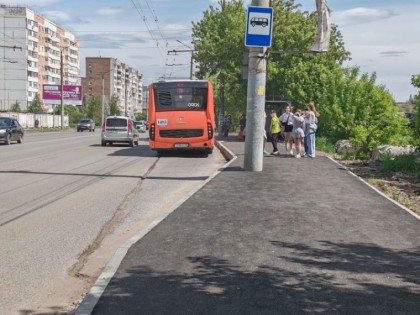
As part of the ongoing reconstruction of bus stops in Tashkent, city authorities have decided to eliminate "bus pockets" (lay-bys). This move was confirmed by the chief of the Tashkent Department of Transport and Road Infrastructure Development Mirakbar Ikramov, in an interview with the Toshshaxartransxizmat press service.
The primary objective of this decision is to provide public transport with genuine priority on the road, Ikramov explained. Pulling into and out of these recessed bays is time-consuming; bus drivers often struggle to re-enter the flow of traffic because other motorists frequently fail to yield, despite being legally required to do so.
Furthermore, for high-capacity vehicles like articulated "accordion" buses, navigating these pockets requires complex and awkward maneuvering. The issue is often compounded by car drivers who illegally park within the bays or at their entry points, creating safety hazards and leading to minor accidents.
Infrastructure constraints also play a role: when multiple buses arrive at once, they often cannot fit into a single pocket. Removing these bays allows for the expansion of waiting platforms to accommodate the growing number of commuters. Ultimately, eliminating bus pockets is intended to create a safer and more efficient environment for passengers, particularly for children and the elderly.
Experts point out that while bus pockets are traditionally viewed as a convenience, they suffer from a litany of drawbacks. As previously noted, these include significant time delays, difficult maneuvering, frequent traffic violations by other motorists, and safety risks for passengers.
The specialists emphasize a simple matter of efficiency: a single articulated "accordion" bus is designed to carry 150 passengers, whereas the average car carries only one or two people. In their view, it is obvious who should be given priority on the road.
Furthermore, the existence of these pockets often discourages bus drivers from pulling up flush with the curb, forcing passengers to step off the platform and walk into the roadway to board. This issue is particularly problematic during rain or snow, when poorly positioned buses make boarding and disembarking a messy and difficult ordeal.
As previously reported, Tashkent is simultaneously working to clear shops from bus stops. As of March 1, 739 out of the city’s 2,871 stops were occupied by retail outlets, many of which were constructed illegally.
Follow us on: