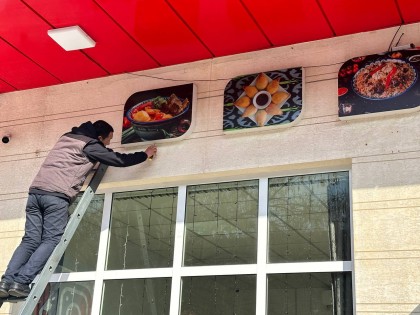
Fast food chains in Tashkent—including Dodo Pizza, Bellissimo Pizza, Evos, Feed Up, KFC, and Papa Johns—have filed a joint appeal against the mass removal of storefront signage across the city.
The appeal was addressed to the Legislative Chamber, the Chamber of Commerce and Industry, and the Business Ombudsman. The restaurateurs claim that since the start of 2026, signage has frequently been dismantled without prior written notice or any opportunity for appeal or voluntary removal. Furthermore, they state that official notices often fail to specify which regulations were violated or how the signs fall short of the city's "design code" requirements. In most cases, businesses are given no time to rectify the alleged issues.
Industry representatives argue that these practices disregard established legal procedures. They also point out that the removals often affect registered trademarks, hindering brand identification and infringing upon intellectual property rights.
The collective appeal demands a temporary moratorium on the removals until clear, transparent rules are established. They are also calling for an open dialogue between the authorities and the business community.
"While we support initiatives to make Tashkent a more modern and well-maintained city, it is fundamental that the law is followed and that the legal certainty and procedural rights of entrepreneurs are protected," the appeal concludes.
One of the business owners shared that signage at several of his restaurant locations was torn down without any prior notice.
"In one district we were warned, but in another, we weren't. They just showed up in the morning and stripped them off. We weren't even given a chance to defend our rights. Since the names were removed, sales have plummeted because fewer people are coming in. If there’s something that needs to be changed, just tell us—we aren’t refusing to comply. But right now, our suggestions regarding the design code are being rejected without any explanation," he said.
Under Cabinet of Ministers Resolution No. 428 (2023), informational signs must not exceed one square meter. Anything larger is classified as outdoor advertising, which requires an official advertising permit and the payment of associated fees. In practice, however, enforcement has been inconsistent: signs have been cleared out in some neighborhoods while remaining untouched in others. An especially large number of "anonymous" storefronts can be seen in the Yunusabad and Mirzo-Ulugbek districts, yet even there, the rules are applied unevenly.
The Tashkent city mayor’s office clarified that the first phase of the crackdown targets signage along 100 kilometers of the city’s 472 kilometers of major thoroughfares. This initial phase specifically includes the Yunusabad and Mirzo-Ulugbek districts.
"If a sign is still standing, it means it was legally registered. If it later turns out that a sign does not meet the new design code, it will be modified in consultation with the business owner," the office stated.
Follow us on: