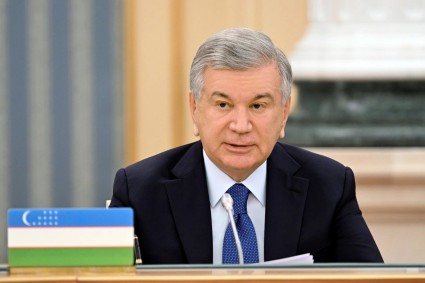
President Shavkat Mirziyoyev addressed the Council of the Heads of State of the International Fund for Saving the Aral Sea (IFAS), the presidential press service said.
In his speech, he noted that expert estimates suggest the water deficit in the Aral Sea basin could double by 2040, reaching 20 billion cubic meters annually. This trend poses significant risks to drinking water supplies, environmental health, the agricultural sector, energy production, and overall social stability.
He stressed that the current situation demands the collaborative development and implementation of comprehensive solutions across the water, energy, and environmental sectors.
President Mirziyoyev shared that Uzbekistan has already implemented water-saving technologies on 60% of its irrigated land and has lined 40% of its irrigation canals with concrete to prevent seepage. Furthermore, modernizing pumping stations has slashed energy consumption in water management by nearly 30%. The country is also building a unified digital database covering over 600,000 water users and more than 4 million hectares of irrigated farmland.
Uzbekistan currently conserves over 10 billion cubic meters of water annually, a figure projected to reach 15 billion cubic meters by 2030.
He outlined Uzbekistan’s priorities for the chairmanship of the International Fund for Saving the Aral Sea, noting that Uzbekistan is assuming the presidency of the organization this year. "Our goal is to transform the Fund into a primary driver of regional integration," he declared.
Developing and Modernizing IFAS Operations
"Building on the progress already made, we must continue to refine the Fund’s structure and legal framework, ensuring a clear distribution of authority among its bodies," Mirziyoyev said. He voiced support for proposals to expand the mandate of IFAS organs, elevating their status and accountability. "I am confident we will find a reasonable compromise on these matters," the President added.
He also expressed hope that Kyrgyzstan would resume full participation in the Fund, noting that their return "would facilitate more balanced and sustainable long-term decision-making."
Aligning the Fund’s Agenda with Regional Summits
"Consultative Meetings of Central Asian Heads of State establish the fundamental political benchmarks for regional development. Therefore, it is vital to ensure a seamless link between the outcomes of these summits and the activities of IFAS," the President stated.
Enhancing Project and Program Efficiency
The fourth Aral Sea Basin Program (ASBP-4) encompasses 34 regional projects. However, Mirziyoyev observed that "a unified approach to evaluating their effectiveness has yet to be established."
To address this, he proposed integrating Key Performance Indicators (KPIs) into the monitoring process. This would allow for better progress tracking, help identify bottlenecks, and make the projects more attractive for funding and technical assistance from international partners.
Leveraging proven financing tools for the Fund's priority programs.
"For instance, we propose utilizing the platform of the UN Multi-Partner Trust Fund for Human Security for the Aral Sea Region, which has a successful track record of mobilizing and effectively managing financial resources," the Uzbek leader suggested.
"We could jointly explore expanding the Trust Fund’s mandate and geographic scope to cover the entire Aral Sea basin. This would allow us to direct targeted investment toward vital environmental and socio-economic projects across all our nations," the president noted.
Establishing active collaboration between IFAS and other regional bodies.
"IFAS needs to build practical partnerships with effective regional platforms focused on water and energy issues, glacier and mountain ecosystem conservation, climate change adaptation, and the fight against desertification. Specifically, we propose that IFAS implement targeted projects in cooperation with the Center for Combating Desertification at the Green University in Tashkent," said Shavkat Mirziyoyev.
Reviving the Central Asian tradition of treating water as the source of life
"It is clear that no amount of engineering will yield the desired results if society’s fundamental attitude toward water does not change. Through a system of lifelong education—from preschool through to professional training—we must strive to make rational water use a daily habit for everyone, a part of our shared cultural DNA," Shavkat Mirziyoyev declared.
He proposed the launch of a regional program titled "Water of the Future" to provide farmers and industrial leaders with hands-on training in modern water-saving technologies.
"We are ready to work actively with international partners, financial institutions, and think tanks to bring these priorities to life," the Uzbek leader emphasized.
Afghanistan as a Stakeholder in Water Management
He specifically highlighted the importance of fostering constructive engagement with Afghanistan, advocating for its inclusion in regional cooperation regarding climate, ecology, agriculture, and water management. He noted the need to secure international donor funding for riverbank stabilization and land reclamation projects within Afghanistan.
"Looking ahead, we must establish a regional legal framework for water resource distribution that respects the rights and obligations of every nation in the Aral Sea basin, including Afghanistan," Shavkat Mirziyoyev stated.
In closing, the President expressed his hope for support in realizing Uzbekistan’s initiatives: declaring 2026–2036 as the "Decade of Practical Action for Rational Water Use in Central Asia" and establishing an annual Water Week across the region.
He also extended an invitation to all attendees to participate in the World Water Saving Forum, to be held in Samarkand in late September.
Follow us on: