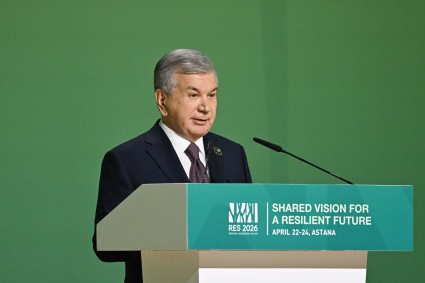
President Shavkat Mirziyoyev addressed the Regional Environmental Summit in Astana, where he delivered a sobering assessment of the climate crisis facing Central Asia. His remarks were released by the presidential press service.
President Mirziyoyev pointed out that average annual temperatures in Central Asia are rising twice as fast as the global average. The region has already lost nearly a third of its glaciers, rainfall patterns have become increasingly erratic, and water scarcity is worsening. Furthermore, land degradation has now affected a staggering 80 million hectares.
“The erosion of global environmental solidarity is deeply concerning. Declarations and appeals are not being backed by actual resources. Countries that contributed the least to global climate change are once again being left to face its consequences alone,” the President emphasized.
The Uzbek leader also highlighted the significance of adopting the "Environmental Solidarity of Central Asia" declaration at the Astana forum, along with a 2030 Action Plan to be implemented in partnership with UN agencies.
Shavkat Mirziyoyev shared that Uzbekistan has planted nearly 1 billion trees and shrubs as part of the "Yashil Makon" (Green Area) project. On the desiccated bed of the Aral Sea, newly established forest plantations now span over 2 million hectares.
“As a result of our large-scale water conservation efforts, we are saving 10 billion cubic meters of water annually,” he stated.
The share of green energy in Uzbekistan's generating capacity has already reached 30% and is projected to exceed 50% by the end of the decade.
He also noted that several waste-to-energy projects are currently underway. Two new waste incineration plants are set to launch this year, with an additional nine to follow over the next two years. Once operational, these facilities are expected to process 5.5 million tons of waste annually, generate 2.2 billion kilowatt-hours of electricity, and reduce emissions by more than 1 million tons.
Uzbekistan’s Proposals to Central Asian Nations for Addressing Environmental Challenges:
- Establishment of the "Clean Air Central Asia" Interstate Consortium.
"This consortium could serve as a joint operator for 'green' financing, aimed at modernizing industry and implementing emission control systems," said Shavkat Mirziyoyev.
- Granting Regional Status to the Tashkent-based Center for Combatting Desertification.
The President proposed elevating the existing center at Central Asian Green University, which focuses on drought prevention and early warning systems for sand and dust storms. "Consolidating our scientific potential within this center will allow us to create a robust monitoring system for land degradation and salt-dust emissions," he noted.
- Formation of a "Green Trade Corridor for Central Asia."
"Introducing preferential customs regimes and the mutual recognition of eco-product certifications will accelerate industrial modernization and make our regional products more competitive," the Uzbek leader stated.
- Creation of a Unified Investment Portfolio for Climate Projects. "This will allow us to move beyond fragmented initiatives and present a cohesive regional development strategy, thereby increasing partner interest in its implementation," the President declared.
- Development of a Unified Regional Atlas of Environmental Change. "This will serve as a fundamental scientific and analytical base, providing a clear visual representation of the dynamics of desertification, land degradation, and the state of water resources across the region," Shavkat Mirziyoyev suggested.
- Joint Publication of the "Red Data Book of Central Asia." The Tashkent regional office of the International Union for Conservation of Nature (IUCN) could serve as the coordinator for this effort to protect regional biodiversity.
- Environmental Education and Youth Engagement. Prioritizing ecological literacy and actively involving the younger generation in sustainability efforts.
The President proposed hosting the World Youth Climate Forum in Uzbekistan in 2027. Additionally, the eighth Assembly of the Global Environment Facility will take place in Samarkand from May 31 to June 5, followed by the World Forum on Water Conservation in late September. Shavkat Mirziyoyev urged regional leaders to participate actively in these international events.
In his closing remarks, the president noted: "Today’s environmental challenges are a test of resilience for all our nations. Fully implementing the documents adopted today will allow us not only to adapt to intensifying natural risks but also to transform them into a powerful catalyst for technological modernization, economic growth, and social stability."
"I am confident that by drawing on our centuries-old traditions of good neighborliness and demonstrating firm political resolve, we will transform Central Asia into a region of ecological well-being and sustainable development," the head of state concluded.