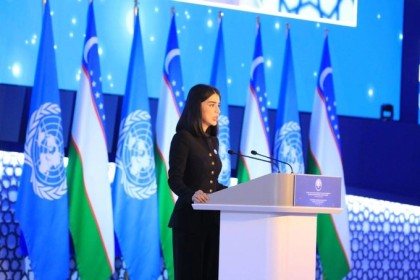
President Shavkat Mirziyoyev has called upon the international community to launch a coordinated offensive against transnational drug trafficking, proposing five key initiatives to address the crisis. His message was delivered to participants of the international forum "Countering Transnational Drug Threats for Public Health and Safety" in Samarkand by the chief of the Presidential Administration Saida Mirziyoyeva.
Shavkat Mirziyoyev emphasized that global unity and resolve are more critical now than ever: "Every day, new forms of organized crime, drug production, and distribution emerge, expanding the scale of transnational threats facing humanity".
"Drug trafficking is becoming increasingly borderless and digital, which further heightens the risks involved. Criminal organizations are utilizing encrypted communication channels, contactless transactions, and complex financial instruments. This requires us to adopt modern solutions and sophisticated approaches to narcotics control".
He expressed deep concern over the widespread use of new synthetic drugs, psychotropic substances, and potent medications among the general population, particularly the youth.
“In Uzbekistan, the fight against drug addiction and trafficking has been transformed into a nationwide movement, mobilizing all available resources”. President Mirziyoyev noted that the National Strategy for Combating Drug Addiction and Drug Crime was adopted in 2024 to formalize these efforts.
In recent years, the detection rate for drug-related crimes has increased 2.5 times, the volume of seized narcotics has doubled, and the amount of destroyed synthetic drugs has grown sevenfold. Last year alone, authorities solved over 15,000 drug crimes, destroyed nearly 3.5 tons of narcotics (including 120 kg of synthetics), and shut down 14 drug labs and 72 major online drug shops, the president noted adding that worryingly youth commit a third of these crimes, with the primary at-risk group being those aged 15 to 30.
"In Uzbekistan, we are not merely dealing with the aftermath; we have launched a massive awareness campaign to prevent drug addiction among our youth. Our primary goal is to shield the younger generation from these threats, guiding their focus toward science and education, and their aspirations toward noble goals".
“The recently established Anti-Narco volunteer movement has already brought together over 17,000 young people. Furthermore, the AI Hackathon national project has been launched across all regions, focusing on using artificial intelligence to prevent the spread of drugs. He expressed confidence that these efforts will help build a robust immunity to drug use among the youth and foster an environment of zero tolerance toward drug-related crimes."
Shavkat Mirziyoyev stated that the battle against drug addiction is a shared responsibility for all of humanity. In this spirit, he put forward several key initiatives from Uzbekistan.
First, the head of state noted that the real-time exchange of information is decisive in the fight against transnational drug trafficking. Uzbekistan proposes the launch of a unified digital platform powered by artificial intelligence to integrate the law enforcement databases of all participating nations. This platform would facilitate the early detection of trafficking routes, identify the movement of dangerous cargo at an early stage, and allow for the real-time monitoring of transnational criminal organizations.
Furthermore, the president continued, the drug trade is more than just the circulation of substances; it is a multi-billion-dollar shadow economy that serves as a funding source for organized crime and terrorism.
"Today, the majority of money laundering for criminal proceeds is conducted through digital assets and offshore zones. The drug trade cannot be defeated with weapons alone, but by cutting off the money. If we strangle its 'financial arteries,' this vice will wither away on its own," he emphasized.
To achieve this, the president proposed the global unification of mandatory identification standards for cryptocurrency exchanges, the implementation of compulsory data-sharing agreements with offshore jurisdictions, and the creation of mechanisms to automatically freeze funds from "unknown sources."
He also suggested introducing an "International Digital Black Code" system. This tool would automatically track the global movement of illicit funds and immediately flag any bank or financial institution that accepts them as high-risk.
“Fourth, to facilitate the exchange of expertise in medical rehabilitation, I call for the creation of the Central Asian Association of Narcologists. Uzbekistan is ready to host the organization’s headquarters in Samarkand.”
Fifth, noting that drug cultivation and distribution persist in certain parts of the world due to limited economic opportunities, job shortages, and social inequality, Shavkat Mirziyoyev proposed developing a specialized development program for high-risk trafficking regions.
“Central to this initiative is the creation of sustainable income sources for local populations through active investment in the formal economy. By improving infrastructure, education, and healthcare, the goal is to reduce the public's dependence on the criminal economy in regions prone to drug cultivation.”
"Such a program should not be viewed merely as a grant or aid, but as a collective responsibility of the entire international community," he emphasized.
The forum is attended by approximately 500 representatives from various nations and international bodies, including Bo Mathiasen, Deputy Executive Director of the UNODC; Tedros Adhanom Ghebreyesus, Director-General of the WHO; Stefano Berterame, Secretary of the INCB; and other heads of major regional organizations.
Follow us on: