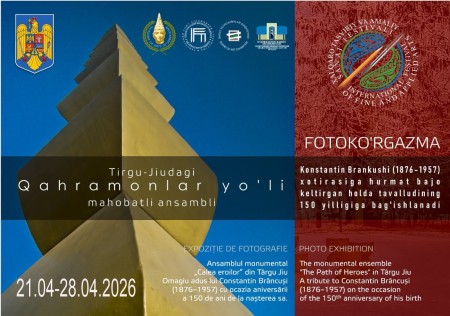
The Embassy of Romania in Uzbekistan is pleased to announce the opening of a photo exhibition, Monumental Ensemble The Path of Heroes in Târgu Jiu. A Tribute to Constantin Brâncuși (1876–1957) on the 150th Anniversary of His Birth, on April 21, 2026, at 5:00 PM at the Kamoliddin Behzod Museum of Oriental Miniature Art (Sharaf Rashidov Avenue, 40). Constantin Brâncuși was a pioneer of modernism and one of the most influential sculptors of the 20th century, known as the "patriarch of modern sculpture."
This event will take place as part of the International Festival of Fine and Applied Arts. The exhibition is organized by the Embassy of Romania in the Republic of Uzbekistan in collaboration with the Academy of Arts of Uzbekistan and the Kamoliddin Behzod Museum of Oriental Miniature Art. The exhibition consists of 21 photographs depicting the monumental ensemble The Path of Heroes in Târgu Jiu, Romania. The Path of Heroes was created by Constantin Brâncuși between 1937 and 1938 as a tribute to the heroes who fell in World War I. The 1.5-kilometer-long sculptural axis, oriented from east to west, includes famous works: The Table of Silence, The Alley of Chairs, The Gate of the Kiss, and The Endless Column. The ensemble was inaugurated on October 27, 1938, and is located in Târgu Jiu, Romania. This cultural treasure was officially inscribed on the UNESCO World Heritage List in July 2024. The Table of Silence is a round stone table surrounded by 12 round chairs, symbolizing anticipation and the moment before battle. The Alley of Chairs consists of 30 square chairs and two benches arranged in groups, representing moments of meditation. The Gate of the Kiss is a travertine monument marking the transition to the afterlife, symbolizing love and unity. The Endless Column is dedicated to Romanian soldiers, symbolizing endless self-sacrifice and consisting of 16 diamond-shaped cast-iron modules. In 2015, the Romanian Parliament declared February 19 Brâncuși Day – a working holiday in Romania.
In recent years, the Romanian-Uzbek relations have been successfully developing in all areas, including culture. Uzbekistan is a very valuable partner for Romania in Central Asia.
The exhibition will be held at the Kamoliddin Behzod Museum of Oriental Miniature Art from April 21, 2026, to April 28, 2026. Admission is free. The Embassy of Romania in the Republic of Uzbekistan invites you to the event.
Constantin Brâncuși (February 19, 1876 – March 16, 1957)
A pioneer of modern abstract sculpture, he created exquisitely crafted bronze and marble works. He is also well known for his sculptures of egg-shaped heads, flying birds, and wooden sculptures, often with folkloric characteristics. Constantin Brâncuși is considered one of the greatest sculptors of the 20th century.
Born on February 9, 1876, in the village of Hobița, Romania, Constantin Brâncuși began sculpting in wood as a child. He studied at the École des Beaux-Arts in Bucharest and the École Nationale des Beaux-Arts in Paris. Constantin Brâncuși created such renowned works as The Endless Column, The Table of Silence, The Gate of the Kiss, The Master, Bird in Space, and others. His sculptures are distinguished by their elegant form and delicate use of materials, combining the laconicism of Romanian folk art with the sophistication of the Parisian avant-garde. The artist imbued his works with a remarkable and transcendental expressiveness. Constantin Brâncuși died on March 16, 1957, in Paris and was buried in Montparnasse Cemetery. The sculptor was posthumously elected a member of the Romanian Academy. Constantin Brâncuși is a true symbol of modern sculpture and one of humanity's greatest sculptors.
Ambassador Extraordinary and Plenipotentiary of Romania
Daniel Cristian Ciobanu