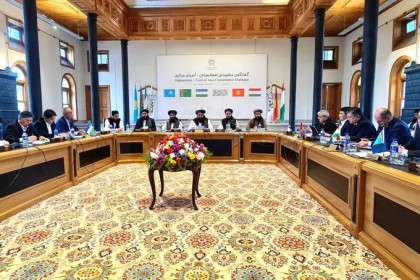
On April 5, Afghanistan hosted its first-ever Afghanistan–Central Asia consultative dialogue, as reported by the Afghan Ministry of Foreign Affairs.
The Kabul-based summit brought together representatives from all five Central Asian nations: Uzbekistan, Kazakhstan, Kyrgyzstan, Tajikistan, and Turkmenistan. This marks the first meeting of its kind in the Afghan capital since 2021; previous engagements with the Taliban leadership had typically taken place in regional hubs like Tashkent and Astana.
Uzbekistan’s high-level delegation included Deputy Foreign Minister Bobur Usmanov, Ambassador to Afghanistan Oybek Usmanov, and the President’s Envoy for Afghanistan Ismatulla Irgashev.
According to Ariana News, the dialogue was initiated by the Afghan MFA to establish a multilateral political framework designed to synchronize diplomacy, catalyze economic cooperation, and advance regional integration.
"Our objective is to broaden the political discourse between Afghanistan and Central Asia, stimulate economic synergy, and solidify diplomatic bonds," stated Afghan Foreign Minister Amir Khan Muttaqi during the opening session. "Furthermore, we will explore collaborative avenues in trade, transit, and regional connectivity."
Muttaqi emphasized that current relations are defined by shared opportunities rather than friction. "Our collective goal is to address regional challenges in a coordinated manner to achieve prosperity, stability, and growth," he added.
Addressing tensions with Pakistan, Muttaqi expressed Afghanistan’s readiness to resolve bilateral disputes through diplomacy. However, he struck a firm tone, stating: "While Afghanistan seeks a peaceful resolution based on mutual respect and dialogue, we reserve the right to defend our territorial integrity."
He further outlined Afghanistan’s foreign policy pillars, highlighting the priority placed on economic partnerships and "good-neighborly" relations. The nation’s strategic focus, he noted, remains on strengthening ties with its immediate neighbors—particularly in Central Asia—to ensure regional security.
Contextualizing these developments, the director of the "Global South" department at Uzbekistan’s Center for Foreign Policy Research Nizomiddin Usmanov, recently said that the hostilities between Pakistan and Afghanistan are heightening border tensions. He warned that this friction creates significant risks for the broader region, even in the absence of a direct military threat to neighboring states.
Highlighting Afghanistan’s recent milestones, Muttaqi pointed to the establishment of a "stable Islamic governance system," the near-total eradication of narcotics cultivation, and a rigorous crackdown on corruption.
He further elaborated on the nation’s economic strategy, which centers on attracting foreign investment and stimulating growth by leveraging trade with Central Asia. Muttaqi shared promising trade data: in 2025, Afghanistan’s turnover with Central Asian partners reached approximately $2.7 billion—a significant surge over previous years. The administration’s roadmap aims to scale this figure to $10 billion within the next three to four years.
Key regional infrastructure that were discussed:
- TAPI Gas Pipeline: Substantial progress on the Herat-Turkmenistan border, with 120 km of piping ready for installation.
- CASA-1000 Energy Project: Accelerated efforts to facilitate power transmission across Kyrgyzstan, Tajikistan, Afghanistan, and Pakistan.
- Lapis Lazuli Corridor & Six-Nation Corridor: Prioritizing trade expansion through deep regional integration.
Security and border management also took center stage. Sharing over 2,300 km of coastline with Tajikistan, Uzbekistan, and Turkmenistan, Afghanistan engaged in talks regarding joint measures to combat transnational threats, including drug trafficking, illegal migration, and extremism.
Afghanistan’s Key Proposals:
- Institutionalize the "Central Asia–Afghanistan" consultative dialogue as a permanent fixture.
- Convene expert-level conferences to draft actionable roadmaps for cooperation.
- Establish a joint security framework to address regional vulnerabilities.
- Coordinate climate action and environmental protection efforts.
- Deepen regional engagement through initiatives like the SCO and "Green Central Asia."
In his closing remarks, Muttaqi thanked participants for their commitment, characterizing Afghanistan’s approach to regional ties as "pragmatic and cooperative." He hailed the dialogue as a historic stride "toward forging a stable and interconnected region."
Follow us on: