The National Dendrological Park will serve as a vital hub for acclimating diverse global flora to Uzbekistan’s specific environmental conditions, Aziz Abdukhakimov, Chairman of the National Committee on Ecology and Climate Change told the Uzbekistan 24 TV channel.
According to Abdukhakimov, the advancement of dendrology carries significant practical weight for the nation. "As part of this project, we are planting species from North America, Europe, Central Asia, East Asia, and the Far East across five distinct climatic zones. In total, the park will house over 10,000 trees and 20,000 shrubs," he noted.
Spanning over 100 hectares, the project aims to cultivate a resilient, mixed-forest ecosystem that mimics natural habitats. Abdukhakimov clarified the park's vision: "There are no plans for restaurants or amusement rides here - the absolute priority is nature conservation."
This initiative extends beyond the capital; regional "Green Colleges" are set to establish their own botanical and dendrological parks of at least 100 hectares each. Furthermore, the committee is shifting toward a circular economy for organic waste: branches will be mulched, and fallen leaves will be processed at composting sites to produce bio-humus for soil enrichment.
"We are shifting toward a strictly scientific approach to urban greening," Abdukhakimov added. "Every planting project now involves soil scientists, climatologists, dendrologists, and foresters. Crucially, each plan must include dedicated irrigation and maintenance systems for a period of three to five years." To ensure accountability, strict penalties will be enforced if saplings perish due to neglect.
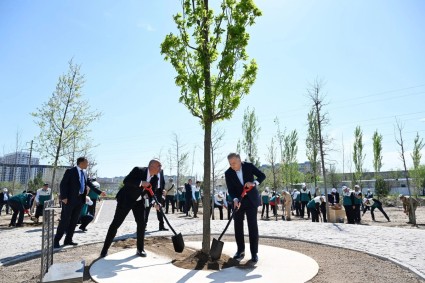
The National Dendropark was inaugurated on April 1 on the outskirts of Tashkent, with the President of Uzbekistan participating in the initial planting. Located in the Qibray district near Tashkent State Agrarian University and Green University, the 108-hectare site will eventually host in vitro laboratories and centers for medicinal plants, seed production, and breeding, operating under a "science-to-practice" philosophy. On opening day alone, 3,000 saplings—including elm, chestnut, birch, oak, and tulip trees—were planted.
Follow us on: