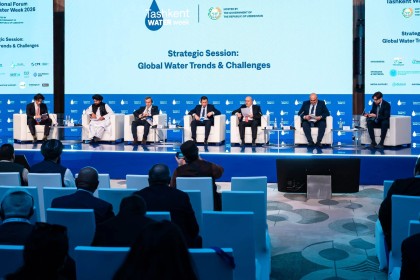
Water has evolved from a purely sectoral concern into a strategic resource at the intersection of economics, climate, geopolitics, and energy. At the Tashkent Water Week forum held in late March, experts gathered to address global trends and the specific regional challenges facing Central Asia. Our correspondent has compiled a summary of their key insights.
Mirshokhid Aslanov, Executive Director of Uzbekistan’s Center for Progressive Reforms, argues that the water issues currently confronting Central Asia demand an immediate shift from outdated assessment methods to real-time monitoring systems.
Historical missteps led to the near-total disappearance of the Aral Sea, triggering severe consequences for the economy, agriculture, and public health. Aslanov believes this history gives Uzbekistan a unique mandate to share both its hard-learned lessons and its innovative strategies for crisis resolution with its neighbors.
Resource management has emerged as the primary challenge for the region’s nations, including Afghanistan, according to the head of Uzbekistan’s Center for Progressive Reforms. For too long, water distribution in Central Asia has relied on mere approximations.
"Regrettably, we still lack precise assessments of our water volumes and continue to manage them inefficiently. We need a transparent approach rooted in hard data," Aslanov stated.
Addressing the issue of transboundary rivers, the expert affirmed the right of Afghanistan and other nations to utilize shared water resources. "We are ready to help Afghanistan avoid the same mistakes we once made. Our experience proves that water must be conserved even when it seems abundant," he said.
Mirshokhid Aslanov urged regional neighbors to establish a unified water management system supported by a shared database. In his view, transparent water accounting will build regional trust and serve as a catalyst for economic growth.
Murad Uzakov, Head of the Center for Regional Studies at the Institute for Strategic and Interregional Studies, highlighted the primary drivers currently exacerbating the region's water crisis.
He argues that the mounting water deficit is inextricably linked to demographic shifts: over the last 25 years, the population of Central Asia has nearly doubled, and it is projected to surpass 100 million by 2050. This surge, coupled with rapid urbanization and industrial expansion, is placing an exponential strain on existing water reserves.
Furthermore, water management remains crippled by systemic inefficiencies and aging infrastructure. Due to the deterioration of canals, dams, and distribution networks, water loss in some areas reaches a staggering 40–50%. Currently, irrigated agriculture consumes roughly 90% of the region's resources—a stark contrast to the global average of approximately 30%.
Inefficient water management is costing the region an estimated $2 billion in annual economic losses. According to UN data, approximately 37% of Central Asian land is already suffering from degradation. If this trend persists, agricultural yields could plummet by 40% by 2050, triggering a widespread food security crisis.
"The water and climate agenda has shifted from being a purely environmental concern to a matter of national and regional security," stated Murad Uzakov. "It now dictates the trajectory of economic development, energy, and food stability."
Uzakov identified global warming as a critical accelerant of this crisis. Temperatures in the region are rising faster than the global average, hastening the retreat of the Pamir and Tien Shan glaciers, which supply up to 80% of the area's water. Over the last half-century, their surface area has already shrunk by a third.
Projections suggest that by 2050, river runoff in the Amu Darya and Syr Darya basins could drop by 5–13%. This shift will destabilize ecosystems, alter rainfall patterns, and increase the frequency of extreme weather anomalies. Uzakov specifically noted the recent rise in "flash floods"—episodes where a month’s worth of rain falls in just a few days.
Ultimately, water scarcity and dwindling agricultural incomes threaten to spark internal climate migration. As rural populations abandon parched farmlands for urban centers, the resulting influx will place an unprecedented strain on city infrastructure and social services.
Against this backdrop, the expert emphasized the urgent need to overhaul current water management strategies. He called for the adoption of effective, harmonized measures that reflect the transboundary nature of the region's major rivers, strengthening cooperation through integrated resource management. The path to mutually beneficial solutions is being paved by a growing climate of trust between Central Asian nations in recent years. As evidence of this positive momentum, he cited the joint utilization of water and energy resources on the Naryn River, the preparations for the Kambarata-1 Hydropower Plant, and hydroelectric developments on the Zarafshan River. He specifically noted the diplomatic progress with Afghanistan regarding the Qosh Tepa Canal.
"Our cooperation on the Qosh Tepa Canal has evolved into a structured expert dialogue," Murad Uzakov remarked. "The formation of a permanent joint working group has allowed us to shift the conversation from the political arena into a purely professional, technical sphere."
Iskandar Abdullaev, Senior Researcher at the International Water Management Institute (IWMI) for Central Asia, has called for a regional transition to a rigorous "water economy." According to Abdullaev, nations must meticulously track their water footprint—maintaining a crystal-clear understanding of exactly where, in what volumes, and how water is being consumed, as well as the specific economic returns generated by those processes.
He emphasized that the modern concept of water security is no longer confined to the borders of a single state or the protection of a single priority industry. Central Asian nations must implement a cross-sectoral approach that respects the interests of their neighbors. Abdullaev placed particular emphasis on agriculture, calling for the advancement of "smart" agro- and biotechnologies designed to maximize crop yields for every single drop of water used.
In assessing the impact of global warming, the IWMI representative shifted the focus from physical resource scarcity to the factor of unpredictability.
"Climate change isn't just about water shortages; it’s about growing uncertainty," Abdullaev noted. "The era when we could rely on traditional planning months or years in advance is over. Today, the situation is in constant flux."
While Central Asian countries are actively investing in infrastructure modernization, reservoir construction, and digital accounting, the expert warned that a purely technocratic approach cannot fully solve the problem. He believes the region is currently undervaluing the potential of natural ecosystems.
"We have neglected our 'green' systems," Abdullaev stressed. "Leveraging them can reduce the need for costly, complex infrastructure, mitigate climate risks, and ultimately save significant financial resources."
In his view, successfully scaling new technologies requires coordinated government action, the implementation of digital management systems at the river-basin level, and collaborative environmental forecasting.
The expert identified the disconnect between the academic community and government structures as a primary barrier to effective water management. In an environment where data is scarce and communication channels between researchers and policymakers are broken, the decision-making process loses its efficacy. This data deficit and poor communication not only diminish the quality of administrative decisions but also stifle the development of the scientific foundation itself.
"We must transition from reactive management to long-term planning," Iskandar Abdullaev concluded. "We cannot limit ourselves to an endless cycle of crisis response."