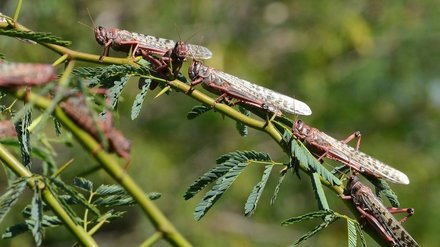
The hatching of harmful locust swarms has been detected across southern and central Uzbekistan, with sightings reported in the Kashkadarya and Surkhandarya provinces starting March 22, followed by Samarkand on March 24, and Jizzakh on March 28. Uzbekistan’s Agency for Plant Protection and Quarantine identified the pest specifically as the Moroccan locust.
Authorities are currently deployed to prevent the infestation from spreading into critical agricultural belts and private household plots. Monitoring efforts have been ramped up nationwide, with intensive chemical treatments underway in identified hotspots.
The Agency noted that this annual containment cycle typically begins in the southern valleys and concludes in the Republic of Karakalpakstan. As of April 1, a specialized task force has been mobilized, equipped with:
- 53 vehicle-mounted sprayers and 194 tractor-drawn units;
- Over 1,000 manual motorized sprayers;
- 25 water tankers and 66 motorcycles for rapid response.
For the 2026 season, experts project that chemical treatments will be required across 651,800 hectares. To date, over 22,000 hectares have been surveyed, with nearly 4,000 hectares already treated. Provinceal headquarters and district-level rapid-response teams have been established to coordinate the effort.
“While Uzbekistan is home to roughly 200 locust species, we focus our annual efforts on 6 to 8 gregarious, highly destructive varieties,” the Agency stated. “To ensure a successful season, our locust control services have transitioned to a 24/7 operational mode, with approximately 700 specialists actively monitoring and countering the threat across the republic.”
The Agency emphasized that chemical treatment services are provided free of charge. Individuals can report locust sightings to the dedicated hotlines at 1288 or 71-202-10-00.