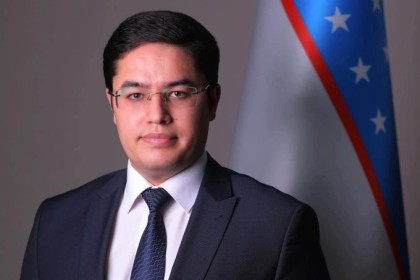
Farrukh Omonov, who has served as the Deputy Chief of the Communications Department of the Presidential Administration (PA) since last July, has been concurrently appointed as the Chief of the President’s People’s Reception. The decree formalizing this appointment was signed by Shavkat Mirziyoyev.
Farrukh Omonov, 37, is an alumnus of the Tashkent State University of Economics and the Academy of Governance under the President. He began his career at the Ministry of Finance and the Chamber of Commerce and Industry. In October 2020, he was named Deputy Director of the Youth Affairs Agency, and a year later, in December 2021, he took charge of the Information Support and Media Relations sector within the Presidential Administration.
This leadership change follows repeated criticism from the president regarding the efficiency of the People’s Receptions. Launched in 2016 upon his arrival to power, these offices were intended to serve as a novel bridge for dialogue between the state and the people.
However, in June 2025, Shavkat Mirziyoyev characterized the receptions as mere "dispatch centers" that simply forwarded grievances to other government agencies. With over half of the appeals received in 2024 remaining unresolved, the president called for a complete overhaul, demanding staff who are "capable of solving problems" rather than just processing paperwork. At that time, oversight of these offices was shifted to provincial governors and district mayors.
Despite these shifts, hundreds of thousands of appeals remain in limbo. Many local governors and mayors have been accused of holding public meetings as mere "box-ticking" exercises. Last year, the bulk of grievances targeted the Ministry of Interior (148,000), the Bureau of Compulsory Enforcement (134,000), the Ministry of Energy (88,000), the Ministry of Employment and Poverty Reduction (60,000), and the Ministry of Health (56,000).
President Mirziyoyev has consistently maintained that the ability to truly listen to citizens must be the cornerstone of government service, warning that ignoring the public's pleas erodes the very foundation of trust in the state.