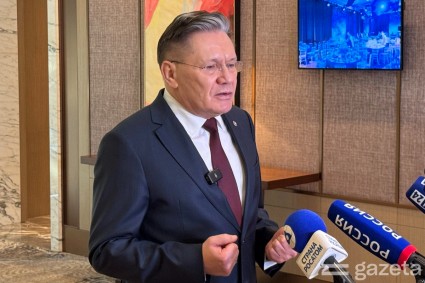
The Uzbekistan nuclear plant project will provide significant economic benefits for Russian industry., Director General of Rosatom Alexey Likhachev told journalists on Tuesday.
Uzatom and Rosatom signed a roadmap for cooperation and an addendum to the contract for the nuclear power plant project Tuesday,. The project will be implemented in a new configuration: two high-capacity power units based on VVER-1000 generation 3+ reactors (1 GW each) and two power units with RITM-200N reactors, 55 MW each. The total capacity of the facility will be 2,110 MW.
The concrete work have now began in Jizzakh province to date.
According to Likhachev, the project has two key aspects for the Russian industry. The first is contracts for Russian companies, and not just those for Rosatom’s subsidiaries but also for private companies and companies in which the Russian state hold stakes.
The small power unit project alone generates 2 trillion rubles (US$24.7 billion at the Central Bank of the Russian Federation exchange rate) worth of contracts. And in terms of job, this means approximately 1,000 immediate jobs, he said.
According to him, the project has a significant multiplier effect on the economy.
"In terms of macroeconomic effects, this represents a return on investment in the Russian Federation of up to 1.5 rubles per ruble invested during the construction phase, and up to 2 rubles during the operation of the nuclear power plant," noted Alexey Likhachev.
"We are always, and especially in Uzbekistan, happy to work on localizing expertise here during the construction phase and during the future maintenance of the plant," the chief of Rosatom stated. Likhachev added that the project is also important from a global competition perspective.
The Director of the Atomic Energy Agency (Uzatom), Azim Akhmedkhadzhaev when asked about the project's cost, underscored that compliance with safety standards, not price reduction, remains key to its implementation.
According to him, the parties have agreed to localize some of the work and procurement, adding that the materials used will undergo mandatory testing.