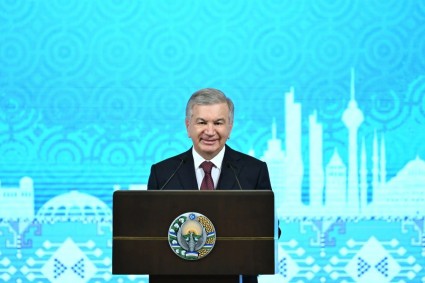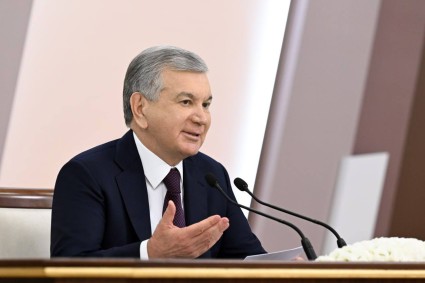
Today, President Shavkat Mirziyoyev chaired a government meeting via teleconference on key objectives for 2026 in terms of poverty reduction and employment.
According to him, Uzbekistan's economy grew by 7.7%, significantly surpassing the initial forecast, to reach $147 billion.
Growth rates across all sectors of the economy were higher than in 2024. Foreign investment reached $43 billion, and exports reached $33.8 billion. Despite strong economic activity and growing consumer demand, inflation fell from 9.8% in 2024 to 7.3%, he said.
"Why am I citing these figures? Because the more sustainable economic growth, the more resources are provided to improving infrastructure. And this ultimately contributes to more jobs, income, and well-being," the president stated.
366,000 families had been lifted from poverty (according to a survey by the National Statistics Committee and the World Bank, 302,000) in 2025, while the poverty rate had fallen from 8.9% to 5.8%, and unemployment had fallen from 5.5% to 4.8%.
All of this is the result of our reforms and evidence that trust between the state and the people is steadily growing, he noted.
However, still a lot remains to be done. 2026 has been declared the "Year of Development of the Mahalla and Society," with objectives set to improve the infrastructure of mahallas (neighborhoods).
"The mahalla is a place where it is clear where reforms are working and where they are stalling. If unemployed and poor families remain in the mahalla, it means the reforms have not reached there."
The president also pointed out that neither ministers, nor governors or mayors, nor bankers have the right to shift responsibility to the others.
"We have the capabilities and resources, the solutions and programs are there. What's missing is responsibility and personal accountability," he stated.
Responsible officials have been instructed to study the potential of mahallas with high poverty and unemployment rates within one month and prepare a methodological guide for implementing best practices. Local mayors shall be responsible for implementing these guidelines, creating jobs, increasing household incomes, and addressing social issues.
"Overall, this year, the activities of each ministry and mayor office will be linked to mahallas, and decisions will take into account the changes they will bring at the mahalla level," the president emphasized.
Goals for 2026
The following goals have been set for the current year:
- provide 1 million people with permanent employment;
- lift 181,000 families out of poverty;
- increase the number of mahallas free of poverty by 2.5 times, to 3,500;
- reduce unemployment and poverty to 4.5%.