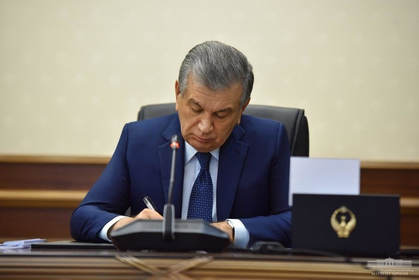
President Shavkat Mirziyoyev has signed a comprehensive law regulating labor strikes in Uzbekistan, introducing clear legal boundaries, worker protections, and severe criminal penalties for violations. The newly enacted legislation, signed on June 11, 2026, marks the final step in a multi-year legislative process, following its passage by the Legislative Chamber in September 2025 and approval by the Senate in April 2026. The law will officially take effect in three months, on September 12, 2026.
The Legal Framework: Defining and Organizing a Strike
For the first time, a formal definition of a strike is integrated into the national Labor Code. A strike is now recognized as a temporary, voluntary, and collective refusal by employees to perform their job duties to safeguard their professional, labor, and socio-economic interests during a collective dispute.
However, calling a strike requires adherence to strict legal protocols:
- Prerequisites: Workers can only strike if mandatory conciliation and mediation procedures fail, or if an employer evades these procedures, breaks agreements, or ignores arbitration rulings.
- Voting Thresholds: A strike must be approved by a general assembly or conference. The resolution is only valid if it secures votes from more than 50% of the participating workers or delegates.
- Advanced Notice: The voting assembly must be held at least one month before the planned start date.
- Detailed Resolutions: The final strike resolution must explicitly detail the points of contention, exact timelines, expected duration, and the names of the chosen trade union leadership driving the action.
- Notification Timelines: Trade unions must formally notify the employer within five working days of the vote. Employers must then notify the state body for labor disputes within 24 hours.
Leadership Powers and Employee Guarantees
Under the new law, authorized representatives from trade union committees will manage strikes. These leaders are legally empowered to request operational information from employers, call worker assemblies, and retain external specialists for expert opinions. Crucially, they are legally bound to uphold the Constitution, seek peaceful resolutions, and ensure no false data is given to authorities.
To protect the workforce, the legislation establishes strict safeguards:
- Participation is entirely voluntary; coercion from any side is strictly illegal.
- Striking cannot be treated as a breach of labor discipline, and workers are guaranteed to retain their jobs.
- While employers can withhold wages from striking staff, any non-striking worker left idle by the industrial action must be compensated according to the Labor Code.
Public Safety, Postponements, and Outright Bans
The law establishes a heavy emphasis on public safety and continuity of governance. Employers and strike leaders share joint responsibility for maintaining public order and safety. High-risk machinery must be stopped immediately if it poses a threat to life.
Furthermore, the state outlines strict boundaries on where strikes can occur:
- Emergency Prohibitions: Strikes are unconditionally banned during states of emergency, martial law, or general mobilization.
- Total Sector Bans: Strikes are entirely prohibited for healthcare workers, civil servants on the state registry, military personnel, judges, law enforcement officers, communications network staff, and utility employees (power and water supply).
- Essential Services Mandate: In critical sectors like rail, aviation, public transit, and hazardous production facilities, strikes are permitted only if a bare minimum of essential services is maintained. The Cabinet of Ministers will finalize this essential services list.
Courts are given sweeping intervention powers. If a strike threatens public order, health, or environmental sustainability, a court can immediately postpone or suspend the protest for up to 30 calendar days.
Stepping Up Enforcement: From Fines to Prison Sentences
To ensure compliance, the government is introducing dual layers of administrative and criminal liability.
Administrative Fines
A new article, 201-2 ("Violation of Strike Legislation"), enters the Code of Administrative Responsibility, calculated in Base Calculating Values (BCVs):
- Illegal Participation: Striking in a prohibited sector carries a fine of 3 to 7 BCVs.
- Leading an Illegal Strike: Organizers face fines of 10 to 15 BCVs (rising to 15–30 BCVs if driven by personal financial gain).
- Workplace Coercion: Forcing someone to join or skip a strike results in a fine of 15 to 30 BCVs. If the victim is professionally or financially dependent on the offender, the fine climbs to 30 to 50 BCVs. State labor inspectors will issue these citations directly to the courts.
The Criminal Code is being amended with Article 218-1. Repeat offenders who lead illegal strikes or use coercion after already receiving an administrative fine will face criminal prosecution. Penalties scale up drastically based on consequences:
- Standard Criminal Offenses: Fines of 100 to 300 BCVs, 360 hours of community service, or 1 to 3 years of imprisonment.
- Severe Damage or Fatality: If an illegal strike results in large-scale property damage or death, the penalty increases to 2 to 5 years in prison.
- Striking in Banned Sectors: Organizing a strike in an explicitly prohibited sector (such as healthcare or law enforcement) carries an automatic 3 to 5 years of imprisonment, escalating to 5 to 10 years in prison if it leads to a fatality or other catastrophic consequences.